Is trouble brewing for Mark Carney in Quebec?
Prime Minister Mark Carney’s tin ear when dealing with Quebec, its premier, and its sensitivities about nationhood revealed itself last week.

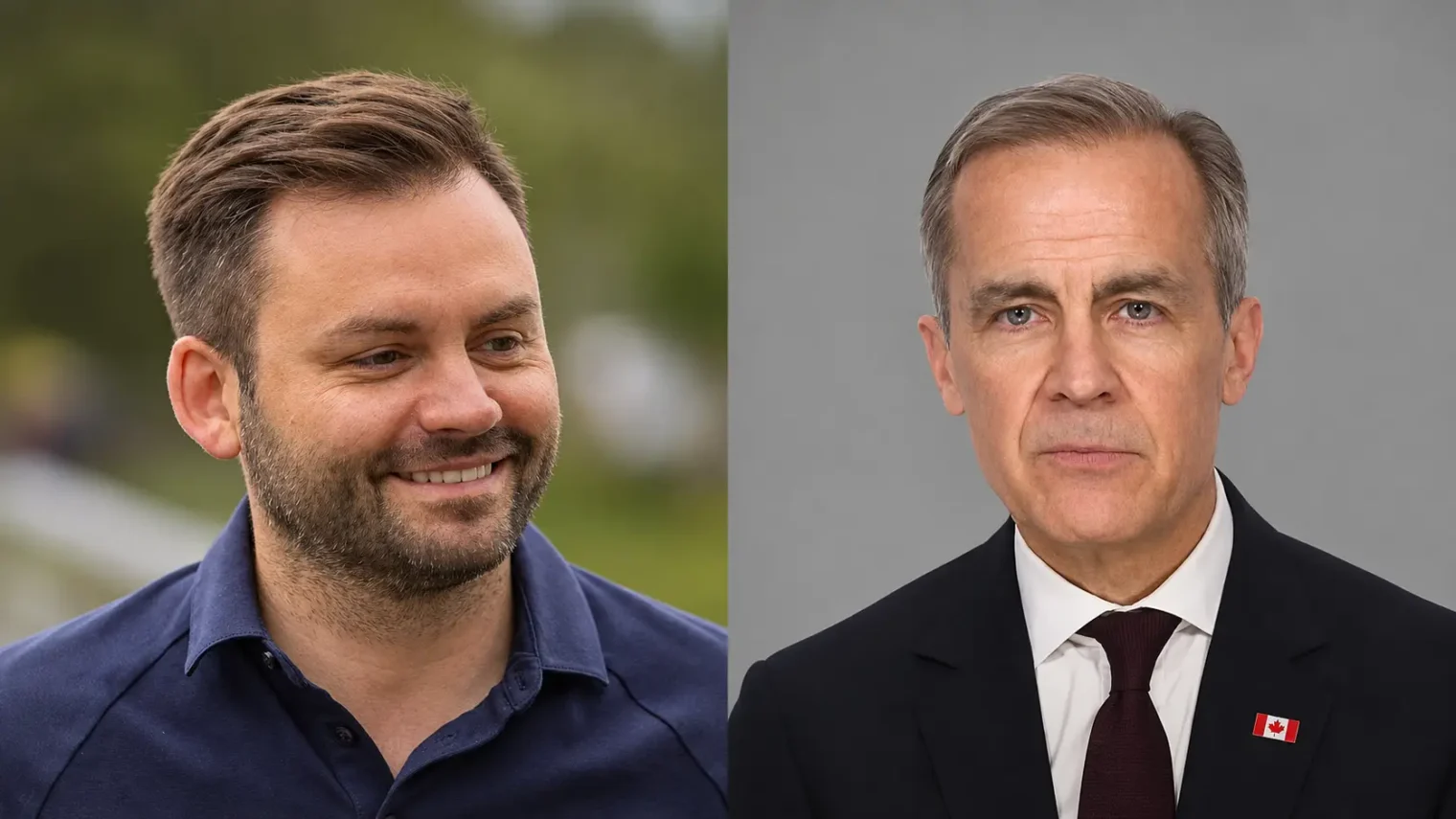
Canada’s prime minister holds a commanding lead in all major election polls. His popularity has remained strong and steady for most of his tenure, beginning in March 2025. He earns high marks when he speaks on the world stage; he represents Canada with dignity and maturity, and he conveys ideas in a sober, thoughtful manner. But his tin ear when dealing with Quebec, its premier, and its sensitivities about nationhood revealed itself last week. Paul St-Pierre Plamondon, Quebec’s new Parti-Québécois premier, fresh from a hard-earned victory in Quebec’s Oct. 5 election, had been in office for a few weeks when Prime Minister Mark Carney picked a fight with him on questionable grounds.
On Nov. 3, as results from the United States came in, St-Pierre Plamondon saw an opportunity to reach out to newly elected members of Congress to gauge their interest in resetting the trade relationship with Canada, which had been badly off the rails since the start of U.S. President Donald Trump’s second term. In writing a letter to 59 officials, including Democrats and Republicans, St-Pierre Plamondon hoped to invite U.S. officials to work with Quebec on joint economic projects that would benefit both sides. When the prime minister caught wind of this, he voiced his displeasure. Citing the need for one person to speak for Canada, Carney said the following at a press conference at Ateliers Belleville artist studios after announcing $4 billion in funding for Canadian arts and heritage: “First, what’s clear is that the decisionmakers of commercial agreements and initiatives for the next three years are the executive of the U.S. That’s clear — the executive, the president. It’s always a good idea to have one single negotiator,” he concluded. “And it’s the field of competence of the federal government for that reason.” Carney’s authoritarian streak surfaced, but it raises questions about his understanding of Quebec, his governing style, and whether his armour has a weak spot.
CARNEY’S TIN EAR ON QUEBEC
The uproar over Carney’s response to Plamondon’s outreach wasn’t the first time he misread Quebec’s nationalist sentiment. Last January, speaking at the Plains of Abraham, he described the battle as marking the beginning of a partnership between Canada’s English and French peoples. Specifically, he said that the site “marks a battlefield, and also the place where Canada began to make its founding choice of accommodation over assimilation, of partnership over domination, of building together over pulling apart.” Many in Quebec disagreed, including political science professor Daniel Beland, who wrote in Policy Magazine that the Plains of Abraham represent a “national humiliation and a durable loss of agency.” Others called it a “historic error,” while Plamondon called the speech a “colonialist” distortion – in fact, a pretext for a referendum, and demanded an apology. Bloc leader Yves François-Blanchet also chimed in, saying the remarks were a “deplorable mistake.”
The prime minister’s actions raise questions. He has been indifferent to premiers Doug Ford, Danielle Smith, or Scott Moe using their offices to advance trade talks. They have all met with multiple governors, but with the Quebec premier, trade became an exclusive federal-government sphere. Under former prime minister Jean Chrétien and Stephen Harper, a Team Canada approach prevailed. Even more unsettling, Carney knows that Quebecers see their premier as a prime minister, on equal footing with Canada’s chief executive.
Thinking of Carney as the boss conflicts with how Quebec operates. St-Pierre Plamondon told reporters that the prime minister “would like us to not put on our skates and never be on the ice because he would like the rink to himself. Welcome to Quebec. We have always taken our place.” He explained, “Mr. Carney is not my boss, and he won’t impede Quebec from doing what it has always done, which is to have an international representation. So in the coming months, expect to have a Quebec that takes its place in the world.” Carney once again stirred up a hornet’s nest in Quebec. Figuring out why a man as intelligent and in tune with European ideals cannot understand Quebec’s sentiments about being in charge of their economy borders on troubling, if not disturbing.
"*" indicates required fields
CARNEY’S GOVERNING STYLE
These events remind Canadians that they did not elect a negotiator or consensus builder when they voted for Carney. They chose a CEO. Our prime minister prefers to decide rather than deliberate. He prefers to command rather than commiserate. Talking lacks action, and in Carney’s mind, nothing defines a leader more than someone who moves, decides, and acts. His opposition to St-Pierre Plamondon could reflect his uncertainty about the Quebec file, but it also shows how confident and determined he remains in guiding Canada through the trade crisis and in claiming victory over Trump. He sees Trump on the ropes after the midterm wipeout, with the president facing his last two years fighting investigations and strong political headwinds. The opportunity exceeds Carney’s resistance. He has charged Dominic LeBlanc with negotiating the trade deal with the U.S., but whenever the prime minister has a chance to use Trump as a foil, to control the outcome, or to bask in his popularity over the American president, he suffers no interference.
He has forced out many of the Trudeau-era Quebec ministers to ensure his wishes are carried out. Gone are Jean-Yves Duclos, Diane Lebouthillier, Pascal St. Onge, Rachel Bendayan, Elisabeth Briere, and the incorrigible Steven Guilbeault. Most remain loyal to the party, if not the prime minister, but Guilbeault appears ready to break ranks. If Carney pushes Quebec or those in la belle province, like St-Pierre Plamondon or Guilbeault, to think the federal government has become heavy-handed in their dealings, there will be blowback that could turn a Liberal romp in Quebec into the equivalent of guerrilla warfare for every vote. Carney’s charmed ascension to power has been meteoric. His efforts could get mired in Quebec politics. If he ignores the warnings, he could join other former prime ministers who took Quebec’s support for granted. Quebecers do not have to vote Conservative to send their message. Blanchet would pounce on any opening, and Carney could be quickly fighting to make up lost ground.
CARNEY’S CLAY FEET
Finding a critique of Carney’s leadership in dominant media publications outside Quebec takes some research. Confronting St-Pierre Plamondon carried risks. Why give the separatist premier a pretext to gin up a referendum? Does the prime minister believe his powers of persuasion insulate him from the problems every prime minister has faced? Does he assume Quebecers trust him enough as Canada’s leader to ignore their own nationalist sentiments? If our prime minister has a weakness (I would suggest he has several), one of them is his unwillingness to admit mistakes, shift quickly, or acknowledge a problem with one of his brilliant ideas. If Carney digs in about insisting that Quebec show deference to him and his office, he will reap the whirlwind. Carney may not suffer fools, but Quebec leaders do not bow to prime ministers. After the dust-up, Quebec’s new premier sent a simple message to the prime minister. Besides advocating for Quebec, St-Pierre Plamondon intends to demand more attention and funding for the homeless in his province and more say on immigration. Concerned about housing capacity, St-Pierre Plamondon was quoted as saying, “We can only conclude that the Carney government is maintaining the orientations of the Trudeau government.” Because the PQ campaigned to reduce immigration, the new government rejects the explanation or justification for the increases. The battle between Quebec and Ottawa over these matters will test Carney’s adaptability and political athleticism. Having once again barked at Quebec, the prime minister may be brewing trouble for himself and his government.